Many people have offered their views and opinions about Ainslie and his work as a painter and as a teacher. Those that were recorded are available as transcripts, unpublished essays, a thesis and a video. They are among the JAF papers and other documents being located in the University of the Witwatersrand archives.
Speaking as a Jungian psychologist, David Trappler said:
Anyone fortunate to find themselves connected with [the JAF], especially during the 1970s and ‘80s, knew consciously or subliminally that they were at a ‘gathering place’ of a unique nature – and at a unique period in time. Something was happening there, that transcended (merely) the formal issues concerned with making art … Bill knew intuitively that making art was serious business, not only to please the eye, but as a vehicle for change.
He also quotes Ainslie as saying, ‘It’s the artist’s job to remind people of that transcendent side which underlies or overlays human activity.’ [90]
Catherine Brubeck, who has maintained a close interest in Ainslie’s work from the mid–1950s until the present, drew attention in an interview to the inclusion of the ‘spiritual’ in Ainslie’s thinking. His early paintings, she said, are ‘kind of political statements’ – not propaganda or social commentary but ‘representational reflections of his concerns and observations’. She compared his early paintings of people with those ‘who painted Africans [and] did so in a very sentimental … smoking-the-pipe manner. Whereas Bill’s paintings weren’t like that at all, if that in itself is a statement. They were much more gritty. If somebody had a tattered coat, it would look as such, it wouldn’t be romanticised. His attitude was that these people were like anyone else, whereas many white painters in South Africa had idealised the ‘noble savage’ as a tourist attraction.’ [91]
The South African writer and editor Lionel Abrahams described one of Ainslie’s typical early figurative works this way:
The first [work] was a huge canvas by Bill Ainslie, one of his mother-and-child compositions, the figures (as in all his work) African but otherwise uncharacterised, suprapersonal embodiments, marvellously corporeal, of their functions and feelings – mother a giantised spirit of protectiveness, the child a miniscule emblem of dependence and instinctual trust, the whole an affectingly forceful illustration of tenderness. [92]
Given that Koloane and Ainslie worked in such close proximity, an observation in 1995 by art critic Ivor Powell of the differences and similarities between their paintings is apposite. Writing about the politics of modernism in South Africa, Powell referred to the relationship between the work of Ainslie and that of Koloane:
There are very obvious similarities between the paintings of the teacher and the student, very obvious tokens of influence – in the strongly gestural use of paint, the sense of the canvas as an arena, the autonomy of the surface, and so on. What is less obvious is that, while the means are shared and the techniques similar, the actual content of the work, the nature if you like of the confrontation with the material, is noticeably different. Where there is an overriding lyricism in Ainslie’s paintings, and a strongly romantic sensibility, Koloane is always harder edged. His references are urban, his light is degraded, his consciousness tends towards the realist assertion. [93]
During the time that he and his family were in the Netherlands in 1970, Ainslie held a solo exhibition at the De Sfinx Gallery in Amsterdam. This is a review of that show, where, reportedly, all the works were sold: [94]
One reads in the invitation that the work is poetic and that it certainly is. Ainslie works abstractly, but it is not the form of the colour areas which determine the character of the work. It is rather in the colour alone. The colour movement is of the greatest subtlety and harmony. This colour is enlivened with an unobtrusive play of lines and bands, a play that never dominates the attention, but rather focuses it on the quiet colour poems that painting is for Ainslie. His work makes one think of dreamy, tender love songs. The great peace that emerges from the work is almost concealed. After having looked at the paintings, I find myself recollecting a particular canvas again and again and being buoyed up by it. I think that this work, if hung in a house will, over time, negate a great deal of the other work. Why the canvases have names is not clear to me. The symbolic value of the titles is so weak and so open to multi-interpretations that numbers would have been preferable. But that is naturally no criticism of the work, which I again eagerly describe as poetic, tender and strong therein. An extremely enjoyable exhibition. [95]
Having been a student of Ainslie and a key figure in the JAF in the 1970s and 1980s, and thereafter with a successful career as an artist, curator and teacher, [96] Ricky Burnett said that Ainslie’s teaching at its best was instinctive or intuitive. Speaking as a leader of his own art studio/centre, he said:
… Bill’s teaching was at its best because it was instinctive or intuitive. It was a humanism rather than a theory. When people have asked me previously about his teaching method, I kind of thought it was a method, because it never seemed to be structured or transcribed or formulated in any concrete sort of way. It was different elements of attitude that would find things to cling to, but essentially it was an attitude to persons. It’s a kind of liberal humanist position that says, yes, we’re all different, yes, we all deserve a conversation which is particular to us at any one time. That learning happens best, as Bill liked to say, when you’re engaged. And an engagement means when some important bit of you is being addressed that isn’t otherwise addressed. [97]
When opening the Bill Ainslie Memorial Gallery at the Johannesburg Art Foundation in August 1999, ten years after Ainslie’s death, the Nobel Prize winning novelist Nadine Gordimer said:
Bill Ainslie was a renaissance man in the full artistic and human original sense. The arts – creative expression in paint, stone, wood, old iron, any medium, as well as the written or spoken word – were inextricably linked and interdependent, for him. He read widely and he understood … the South African writers’ mission to find adequate expression for the states of being and experience in our country, and also the mission of visual artists … Bill’s vision was all-encompassing: he took it all on, with remarkable insight, intellectual courage, great warmth. What this meant in times that were discouraging, to say the least, and filled with horrifying events, at worst, was tremendously important to keep the obstinate life-assertion of our people’s creativity alive. [98]
Reviewing Ainslie’s 1972 exhibition, known as the ‘Wilderness’ show, The Star’s reviewer John Dewar asserted that, for him:
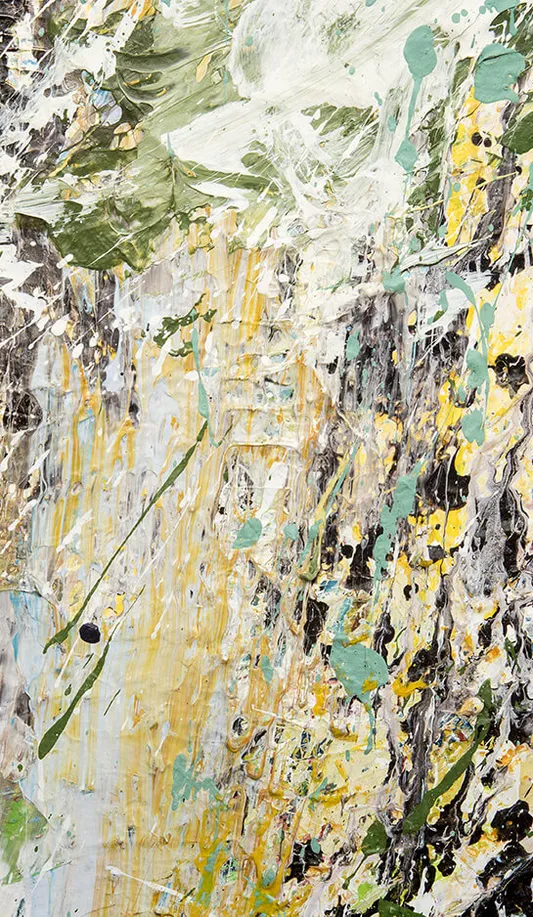
Ainslie’s canvases achieved what more artists should do – sloughing off of the last remains of conventional artistic hang-ups … to leave a clearer thinking for the analysis of simplification. His simplified [read abstract] paintings, have, he says, realistic roots. He calls them Namib paintings and they do evoke visions of wind, dust and rock of desert regions. Despite being extensions of his personal painting intellectualism, their colours, and what form there is, have an attraction, a subtlety and a kind of mysticism. [99]
The interlocutor in the monograph Bill Ainslie 1157 said this about the ‘Wilderness’ paintings:
Two paintings … were hanging on the wall in his lounge. They hung side by side forming a diptych, the left one being predominantly yellow and the other greenish-yellow. Both paintings are divided into three vertical panels of colour surrounded by a band of the dominant colour of the respective paintings. The vertical panels of both paintings are practically mirror images as far as colour gradation is concerned. In the outside panels the colours are varied from the basic ground colour and the impression created in both is of turmoil which gradually changes to skeins of colour through the middle panels and into light and tranquil use of colour in the central panels. He calls them ‘Wilderness paintings’ because they were a rejection of all explicit object such as landscape, still-life and figure … He realised that he was searching for an emptiness, a wilderness, and named them after the oldest wilderness in the world, the Namib. [100]
In her obituary of Ainslie, the artist, critic and scholar Elza Miles (née Botha) wrote:
Bill Ainslie did not turn his back on Africa when, in the 1970s, his painting became connected with American abstract expressionism. On the contrary, his involvement in South African life never diminished for one moment. With the same conviction that he expanded the vista of his paintings, shifting its focus, he bypassed the restrictions of statutory apartheid. Bill and Fieke’s house was open to the homeless and in Bill’s studio and, later, at the Johannesburg Art Foundation, all students received equal attention…
David Roussouw, a former student at the art foundation, remembers that during workshops Ainslie read to them from Sufi wisdom. In view of the controversy surrounding Ainslie’s espousal of abstract expressionism, one looks for an answer to his critics in Idries Shah’s Thinkers of the East. There one reads about Rumi, who was accused of straying from the True Way by encouraging and permitting acting, song, music and other unconventional activities. Some say that he ignored the charges, others claim that he defended himself thus: ‘Let us see whether in time to come it is our work that is remembered, or the names of our critics.’ [101]
Writing about Ainslie at the time of his death, Sipho Sepamla, poet, editor and director of the Federated Union of Black Artists (FUBA), said:
I shall never forget Bill. He was one of a handful of whites I got to know as human beings. Many times we spoke as equals and friends; we fought as human beings and reconciled as lovers. I am sure that I learned a great deal from him. Certainly he taught me to persevere and be patient in running a project like FUBA. Often he recited to me Confucius’ advice on how small beginnings were better than spectacular ones. [102]
Anthea Bristowe, writing for Business Day about the exhibition of Ainslie’s Pachipamwe paintings at the Johannesburg Art Gallery, added to her comments on the paintings by saying:
By their nature visionaries are controversial and Ainslie was no exception. A disciple of abstract expressionism himself, he stands accused of being ‘part of a conspiracy to brainwash black artists with a deadly dose of American imperialism’… Ainslie’s legacy is complex. It is fashionable to be dismissive of modernism. The essence of what he taught his students was to know and understand their materials and to work with them, acquiring the necessary skills and tenets of their craft, and leaving the concepts for later. Their individual voices, he believed, would develop in time. [103]
Art critic Hazel Friedman, considering Ainslie’s Pachipamwe paintings, said ‘it seems that Ainslie was truly about to come into his own as a formidable abstract painter’ when he died. She concluded her review with:
Although the painter himself was very much a man of this world, with its conflict, pain and promise, his last works seem almost otherworldly, dematerialised. And, using the words of the international artist, the late Paul Klee, Ainslie’s final paintings come perilously close ‘not to rendering the visible, but rendering the invisible’. It was one of those cruel ironies that Bill Ainslie’s quest was curtailed, just at the point when his aesthetic influence had really begun. [104]
Ricky Burnett was able to follow Ainslie’s interests in poetry, philosophy and theoretical explorations, such as readings and discussions of Robert Graves’ The White Goddess. As Pat Williams in her comments on the Pachipamwe paintings does, Burnett points to the continuities in Ainslie’s work, rather than seeing the latest works as a ‘breakthrough’:
It appears to me that he obviously cleared away a lot of obstructions. This may be the one occasion [Pachipamwe] where it is much more evident, much more focused and much more fruitful than it had been in the past. But I don’t think Pachipamwe itself removed the obstructions. I think he removed the obstructions himself, very slowly over a long period of time … I suspect he had just reached the moment when he was about to start making paintings that were really significantly his. I think they were all ways of dealing with other paintings or other kinds of issues. I think he was starting to get rid of a lot of his complications. That is why everyone thinks of Pachipamwe as this breakthrough because it was all so quick and because they had a freshness and speed and a directness of him getting rid of complications. [105]
Working with the Hard Stuff
an essay by Ricky Burnett
It was the best of times for some and the worst of times for others. It was Johannesburg !973. Whiffs of new freedoms, in music, art, education, and lifestyle, drifted in from Europe and America. In the public sphere, however, the callous fascism of apartheid hardened. Despite this, for some of us, the aura of the sixties still glowed. I was privileged to go to university in 1967, leaving behind a small West Rand town with its English vs Afrikaans school rugby rivalry and its Paardekraal monument. While I lived there with my parents and young brother the town and everything it stood for was not a natural home for me. In Krugersdorp I was shy, barely articulate and alien. But not at the University of the Witwatersrand, its broad collective mind a welcome antidote to the small and the petty. It was the student mind more than the academic mind that drew me. The sixties were not just about music, free love and dope. There was the politics; French students questioning the education system, American students urging for the end of the war in Vietnam, English students bred in the English socialist tradition arguing against the hegemony of monopoly capital and imperialism. German students showed a tendency to want to blow things up. There were, then, thrilling cultural and intellectual tides drifting across our lives and, happily, subverting the constrictions imposed by the government - heady times. We read Herbert Marcuse, Ronald Lang and Jean Paul Sartre, had a Sunday night group reading Les Misérables. We had sit-ins, mass meetings and protest marches and we were mightily pissed off when a black academic was prohibited by the government from taking up a position at the University of Cape Town. Students then built schools in what was called Swaziland and we initiated and managed welfare services and clinics. It was learning and activism conjoined. The best of becoming a young adult for me was that it was entirely extra-curricular – and a full-time occupation.
“You don’t have to be good,” wrote Mary Oliver. And a few lines later she says, “You only have to let the soft animal of your body love what it loves.” For ‘Body’ I read self. The soft animal of my self (i.e. body and mind) loved intoxicants both physical and otherwise. I dropped out of university, turned on and tuned in, as a trope of the time went. I tuned in, not to cosmic metaphysics, but to the jumbled and intoxicating world of a kind of literary all sorts, musical all sorts, all sorts of poetry and painting. How to live that life?
Along came Bill.
Bill had a compelling curiosity and a genuine concern for those around him, especially those that cared about painting. Bill was serious. When I first met him he had a little school catering to part-time, mostly once a week, aspirant painters. I arrived on his doorstep carrying that question, “How to live that life?” and so too, fortuitously, did several other similarly driven young twenty-somethings.
We became his first full-time students. We had a home, a caring tutor and a “soul” open to engagement. I could talk seriously with Bill as I could talk to no one else. His most significant and enduring impact on my thinking came not just from his guidance and challenging critiques but also from the example of his practice as a painter. Bill had a strong sense that there were both moral and ethical values held in the vocation of “proper painting.” This has little to nothing to do with “correct technique”, nor with aesthetic conformity, and nor has it to do with argument, declamation, statement or narrative. The foundational question of “proper painting” derives from a question posed by Meno in the Platonic dialogue of the same name, and it is this, “How will we recognise the nature of that thing which is unknown to us?” There was good behaviour that led to authenticity and there was bad behaviour that led to lies.
At the time the American Abstract Expressionists and their painterly progeny, were to our eyes the champions of Meno’s question and, I believe, they reached into a places where no light had shone before. From what strange well did Mark Rothko, say, or Clifford Still, draw their very new and very particular images - images that became a Rothko or a Still? Each painter had a look that became them. The boldness of their move was to relinquish the hold of all things pictorial so as to explore the explicitly painterly, painting without the naming of things, without people, places, and events. “Proper painting” is difficult and so it should be. It’s the tussle that brings the reward. It is shaped by a clutch of core values, here are a few:
The authentic yield of studio work is the result of discovery and not of production. (Imitation is not at all a bad way to learn but it is a poor place to stop.)
The primary means of transmission from artist to audience (what some might call communication) is the material, the paint.
The paint is animated by touch. “Touch” is the artist’s presence.
His or her choices (touch; hard/soft, colour; dull/brash, texture, slight/crusty, and so on) are evidence of their consciousness.
Rothko wished it to be understood that his paintings were not about experience but were the experience.
For a painter like Bill Ainslie these operating principles constituted, not a wish list, but an ethical framework.
During my close association with Bill (most of the 1970s) I don’t believe I ever saw him start a new painting. Drawings yes, (mostly portraits) and, also, a large mixed media black and white work of, three or four, floor to ceiling panels. But no new paintings, though, he did of course paint. Time and time again he revisited the same squad of rectangles. (I re-stretched a few of these works as the stretchers had cracked, broken and warped under the weight of accumulated paint. It took some effort to lift them.)
His studio was a battleground and the battle was private. He was not at this time painting to produce. He was painting to uncover.
Hernandez de la Fuente has written that Marcus Aurelius wrote Meditations, “not for us to read, but rather as the vehicle that this cultured man founded to question himself.” “It was a book,” wrote Ryan Holiday, “for the author, not for the reader.”
Bill Ainslie’s decade of privacy was both true and exemplary. It was the time of discovery, a search for he knew not what through the rugged terrain of self and matter.
His search took place on two fronts. Firstly, the urge to physicality. The weight of accumulated paint was not gratuitous, it was acquired through the pursuit of the image as mass. Secondly, he felt too, the urge to be expansive. His big tussle was with small tubes. Small tubes of oil paint simply didn’t give him enough load mark by mark. Small loads led to segmented areas, too many boundaries and edges. Liberation came to him in the form buckets of gel, a thixotropic medium, that infused with pigment, allowed him to behave with unrestrained generosity, to sweep his arm from left to right unchecked, to play with wind speeds. The scars of wrestle and tussle, the additions, demolitions and alterations are a history and hence they speak of the painting’s personality. The big stuff of Bill’s paint is the painting willing itself out of the frame and into the world. Real for him did not reside in the vaporous. It lay rather, in a confrontational physicality, a kind of head-butt-bulk.
The marks made by brush, palette knife and other implements are the actors in both a drama and a game. Characters comport as stroke, slash, hack and stab, and interact as thrust and parry. In a field of play the characters move fast. One may make a long looping kick down field, and another jinx left then right, another might make a quick pass out of the back of the hand, and several others might crash and fold into a compressed coagulation. Speed is a significant element in Ainslie’s later work. It belies the sheer bulk of stuff. Speed of action coupled with speed of thought, and both rooted, firmly, in time and matter.
The ten years of tussle was not about finding a way to look “good.” He was testing and rehearsing ways of “behaving-well-with-paint,” ways of behaving like nature, our paradigm, conscious or otherwise, of creativity. What Spinoza called Natura Naturans.
Notes
-
90
Alex Dodd, review of the exhibition of Ainslie paintings and drawings at Afronova Gallery, Art South Africa, vol. 5, no. 1 (Spring 2006), p. 74. ↩
-
91
Catherine Brubeck, interviewed by Vanessa Anderson, ‘The Use of Abstraction’, Technikon Natal, 1999, vol. II, pp. 12-13, 61. ↩
-
92
Patrick Cullinan (ed.), Lionel Abrahams: A Reader (Johannesburg: Donker, 1988), p. 160. ↩
-
93
Ivor Powell, ‘“… us blacks …” Self-construction and the politics of modernism’, in Ricky Burnett (curator and editor), Persons and Pictures: The Modernist Eye in Africa (Johannesburg: Newtown Galleries, 1995), p. 22. It is worth noting that, in the late 1980s, Koloane’s paintings began to include more and more ‘representational content’; see Powell, p. 23. ↩
-
94
Natalie Nolte, ‘Bill Ainslie’, 2000. Available at: http://www.billainslie.co.za/natalie%20essay.htm (accessed 3 February 2011). ↩
-
95
J. van Doorne, ‘Painted poetry’, review in Trouw newspaper (Amsterdam), 20 May 1970; translated from the Dutch. Though there are some slender leads, it has not been possible to track down examples of work from this exhibition. ↩
-
96
These include his curation of Tributaries (1985), called ‘the most exciting collection of South African art ever seen’; a ground-breaking exhibition of Jackson Hlungwane’s work; and, after his return from abroad in 2007, he both curated a series of shows and held major exhibitions of his own work. He continues as an artist and private teacher of art. ‘About Ricky Burnett’ [online] available at: https://rickyburnett.com/about-ricky (accessed 21 November 2022). ↩
-
97
Ricky Burnett, interviewed by Elizabeth Castle, May 2014. ↩
-
98
Nadine Gordimer, ‘Living On: The Work and Life of Bill Ainslie’, 29 August 1999. ↩
-
99
The Star, July 28, 1972. ↩
-
100
Bill Ainslie 1157, p. 12. ↩
-
101
Elza Miles, ‘Making images for a rebellious continent’, Die Vrye Weekblad, 8 September 1989. Translated from the Afrikaans by Marcelle Manley, with emendations by Michael Gardiner. ↩
-
102
Sipho Sepamla, ‘The Dream Lives On …’, New Nation, 8–14 September 1989, p. 11. ↩
-
103
Anthea Bristowe, ‘The soul of Ainslie in art and teaching’, Business Day, 16 September 1992. ↩
-
104
Hazel Friedman, ‘Bill Ainslie’s talent was in fine flower’, The Star, 23 September 1992. ↩
-
105
Ricky Burnett, interviewed by Vanessa Anderson, ‘The Use of Abstraction’, Technikon Natal, 1999, vol. II, pp. 101-102. ↩