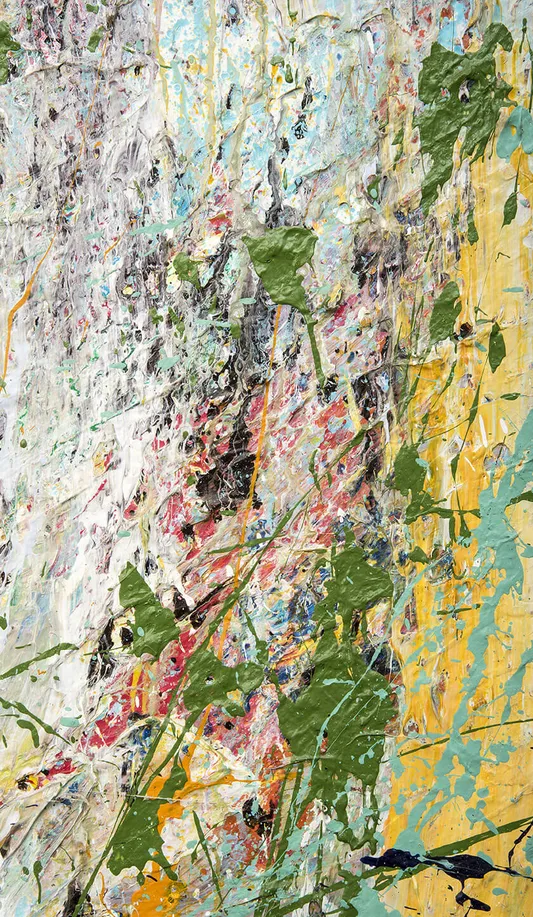
As an artist and teacher, Ainslie ‘spoke’ about art in a number of different ways. For example, he commented on his developing work to friends, interviewers and the interested public. In particular, he recorded in letters and notes the changes and difficulties as he sought continuously to achieve the finest possible expression of his skill and insight.
A further form of ‘speech’ about art is to be found in Ainslie’s focus on developing spaces and environments conducive to art-making. The workshop, as he conceived it, was a major form of expression and required the most careful cultivation.
Most eloquent of all is his presentation in paint of the best contribution he could make to his world with works that are beautiful, poetic and spiritual. Responses to this go beyond the verbal.
Public speaking
When he was an art teacher at Cyrene Mission in 1960, Ainslie challenged the tradition of painting taught there because it had become frustrating for artists to work only on minute scale, using flat and unshaded colours and having to observe other external requirements. [17]
In 1961, Ainslie contributed a series of articles on art and society to The Bulawayo Chronicle. Having to use black-and-white illustrations, he discussed ideas of modernity, twentieth-century art, and art’s ways of reflecting human concerns and issues of contrasting cultures. [18] In so doing, Ainslie offered the readership of the newspaper ideas not easily accommodated by notions of racial colonialism.
Once in Johannesburg, in 1965, Ainslie published a letter to four well known, Johannesburg-based artists who were exhibiting together at the Adler-Fielding Gallery in a show titled ‘Four African Artists’. They were Ephraim Ngatane, Andrew Motjuoadi, Louis Maqhubela and Lucas Sithole.
Ainslie’s letter did an extraordinary thing: it addressed the four painters as colleagues, as one might elsewhere in the world but not in South Africa then. The implicit assumption was that concern with art transcended apartheid’s values of separation, supposed incompatible differences and racial division.
In this letter, Ainslie declares, ‘Most white South Africans are not really interested in art, and this is because they have such a limited interest in life.’ Then, commenting directly on the work on show, Ainslie writes:
Here I find there are no unpeopled landscapes, no superficially patterned abstracts, no decorative still-lifes. Your works are concerned with man. And yet there is something missing … Too much of your work shows man only on the outside, not enough gets inside him. Do we all, black and white, fear to see him whole? [19]
In addition to his stance, which Koloane later described as ‘fearless’, Ainslie revealed a passion in response to the frequent and common failure of the work by both Black and White artists to address the issues that were important in people’s lives. He went on to establish respectful working relationships with these artists, especially Maqhubela. A joint exhibition of work by Ainslie and Maqhubela would be of great interest.
Speaking during an interview with a reporter from a news magazine in 1977, Ainslie said the following about the state of art in South Africa:
I am interested personally in the problem of inertia and demoralisation … Both black and white art reflect frustration and defeat. There is no great difference between them. But what factors might set the sap moving again? That’s what interests me. Can you structure a reply to alienation? [20]
Once again, Ainslie viewed the issues as affecting everyone, displaying a consistent ‘whole-ism’ that underpinned his personal quest for completeness in a divided and fractured society.
A further example of Ainslie’s interest in the role of art in society is contained in the following statement:
Without art, politics is corrupted by a false notion of power and becomes brutalised; science and technology are corrupted by false notions of insight and reason becomes sterile, reductive and polluting; industry, technology and commerce become materialistic, self-seeking and exploitative. Religion is corrupted by false notions of the spirit and becomes superstitious, self-righteous and sectional. [21]
What Ainslie had in mind when making this blunt-seeming statement is contained in his next response to the interviewer about art’s usefulness:
… in a materialistic culture, art will seem useless because it involves the question of meaning. It actually challenges people on the level of what they are alive for. Whether they exist for the sole purpose of perpetuating the existing social, political or economic structures or whether they are alive for the quest for personal meaning within that context and a striving to preserve personal integrity. [22]
When Ainslie was located in a permanent place, he was able to assemble around him a flexible community of people with whom he shared the concerns and satisfactions of art-making. Like many people in 1980s South Africa, he sought to form an island of sanity and creativity.
Speaking about his own work
This is what he said in 1979:
I started off in painting with certain preoccupations. These preoccupations changed. But one thing that has remained continuous for quite a while has been the attempt to almost slough off a skin of inherited ways of doing things. That which is called derivative … And I think it takes a long time to do good work, and to actually discover where the true sources of one’s expression lie. I know what I have so far rejected. I don’t yet feel that I have got through fully at all to what is really trying to come through. [23]
Speaking in the 1980s, Ainslie repeated his view that South African art was ‘essentially derivative’ and that it conformed to staid and conventional practices when not copying British and American developments in art. Instead, he believed:
Art is very much a challenge to the taste. It is a challenge to one’s accepted notions of life. It is an opening up of new possibilities, of a new sense of meaning. [24]
Ainslie struggled to shake off his historical, cultural and familial legacies as well as the powerful influence of Douglas Portway in the process of finding his own voice. This quest became acute once he abandoned figurative painting.
Having completed two successful solo shows in Johannesburg, and before going abroad, Ainslie accepted an invitation to exhibit at the Durban Municipal Art Gallery, which did not usually offer opportunities like this to individual artists.
On that occasion (the only one of which I am aware), Ainslie typed up his address for the opening of the show, which contains a number of interesting statements. [25]
To begin with, the audience in Durban was told of Louis Armstrong’s response to the question, ‘What is jazz?’ He said, ‘Ma’am, if you has to ask, you ain’t got it.’ Ainslie then said:
If these paintings seem strange and objectionable, there is nothing I can say to make them acceptable. If they seem strange, but not objectionable, then perhaps there are a few things one can say about why they are like they are, that could help an interested stranger in his approach to them.
His assertiveness here, as an opening gambit, speaks of a fragile confidence in his art. But there is deep sense in what he said about freedom from prior uncertainties and inhibitions:
Today, the artist is not required to subordinate his vision to any prevailing code – whether religious, nationalist, or otherwise – he is free to paint whatever moves him. Today the artist does not inherit his ideas from a single cultural stream as in the past. The modern world confronts him with the art of many cultures, and many different time periods, and artists today are making use of this new, and rich inheritance. This means that, though the artist can be as eclectic as he wishes (e.g. ‘realistic’ or ‘abstract’), there is no room for the sort of provincial tyranny that insists that only art of a certain sort is capable of moving us.
This assertion is against the provincialism of the South African kind, with its legacy of colonial and cultural (and hence racial) bigotry. Art, Ainslie asserts, is bigger than and not subordinate to the national, the local or the contingent.
Turning to his own work on show, Ainslie pointed to the African origins of the imagery – such as ‘dust, dung, rock, lichen, mud, stains, spoors, bones, carvings, masks’ – and the Eastern (as opposed to post-Renaissance European) sense of space in his paintings. And then he concluded:
This imagery, this manipulation of space, this technique, I have attempted to use to evoke a painting which, for want of better words, is symbolic of a certain mood or state of mind. A mood of waiting, of inactivity, of expectancy, sometimes hopeful and sometimes fearful. This is why most are called Vigil.
When showing new work in Johannesburg in 1968, he said:
My last exhibition had a few paintings which indicated a new interest for me: something very different from the big figures. This is the first show of mine devoted to this new vein to be held in Johannesburg. Discovering Douglas Portway’s work was an important experience for me. [26] It led me into making a more careful assessment of what is called ‘abstract expressionism’. I discovered painters like Sugai and Mušič, whom I had never heard of before, and I became fascinated by the possibilities of combining multiple images derived from memory, and working them together to create a mood. Paintings symbolic of a mood, but carrying landscape or natural references coming from this country – that is what this show is mainly about. [27]
Having abandoned the figurative mode by this stage, his work had qualities of colour-field paintings. [28] They reflected obscure depths, enigmatic semi-suggestions with inevitable indeterminacy. They were thus reflective of private dreams and ‘moods’. For some sympathetic observers, the big canvases were successful reflections of ‘mood’ but, for others, they were without sufficient conviction, seeming to reflect uncertainty in Ainslie himself.
However, a reviewer of the 1968 show at the Goodman Gallery in Johannesburg wrote, ‘By painting this way, Ainslie is free to allow his whole being, not just his conscious processes, to be expressed on canvas.’ [29] Speaking to this reporter, Ainslie said, ‘I find myself drawn to the New York school of painting. Men such as Rothko, De Kooning and Rauschenberg have influenced me – the American abstract expressionists generally’. Therefore his colour-field focus was transitional.
The business of Ainslie and ‘abstract expressionism’ is not addressed here because it became only one part of Ainslie’s expanding repertoire of techniques and, more importantly, was one element of his full move into abstraction. In his Durban and Goodman shows at the end of the 1960s, Ainslie explored the different languages of paint in which its formal properties, such as imagery, perspective, calligraphy and so on, were taken from different sources and eras.
Ainslie’s major concern at that time was that he wanted to make his own kinds of paintings, which were not about Africa but which were African. [30] It is my contention that he did so by invoking the powers of the poetic and the beautiful. Such matters can be discussed by attending to the work he produced in the 1980s, including the astonishing set of paintings he made at the Pachipamwe workshop days before his death.
Letter from St Ives and his ongoing battle with the influence of Portway
Writing to Lettie and Michael Gardiner from the Netherlands in February 1969, Ainslie summed up his need to shift beyond the strong influence of Portway’s work in the following way:
There is one thing that irks a bit though – and that is that if people don’t like my new work, and I grant that it is not all good, then they say I am too influenced by Portway. This is the bogy I must knock. I am influenced by Portway, as Portway was influenced by a whole host of others. Now I am pretty sure that we both want our paintings to be fresh, to be radiant or beautiful, to be subtle and sensitive – and there are other things we may want too, we have the same attitude towards it. I sensed this in South Africa and it has been confirmed in St Ives. And, of course, I have learned a lot. And I grant that Douglas, as a mature painter, has done things that I have found so irresistible that I have felt pressed to try them too. But that is the end of the matter. I know in my bones that I am a different person – that the world has impinged on me in a different way – and I know that the distinction between us will become clearer. [31]
It is evident from his two solo exhibitions in the 1980s and the Pachipamwe set of works that he had, in fact, made the distinction between himself and other artists very clear.
Notes and thoughts
Though there are no examples currently available of Ainslie speaking about his painting in the 1980s, there are examples of other thoughts in the notes that he made when clarifying his own thinking about matters.
To clear his mind, Ainslie used to write his thoughts and ideas in his large, legible handwriting. It is most likely that he never used a computer.
In response to a showing of works by Sue Williamson in the late 1980s, Ainslie handwrote five pages titled ‘Draft notes on Protest art’. Here are two extracts:
The greatest quality required by a Protest artist is courage, plus concern and the ability to strike on a way of painting this in a clear manner. The greatest quality required by the artist is the determination to adhere to the constraints and illuminations of the inner eye – frequently against the pressures to conform to a more popular and public view of things.
He said that Feni was the first artist he worked with who registered the disturbances that plagued the country. He then remarked that artists such as Mandla Nkosi and Helen Sebidi had begun to do the same. He went on to say:
… but I do not understand this to be Protest art in the strict sense. It is art in the broader sense in that it articulates a personal response to public events, and achieves this through a struggle against the conditional forms of conventional and academic stereotypes.
Ainslie concludes his rumination with ‘All art is propaganda; not all propaganda is art.’ [32]
The final instances of Ainslie’s voice are those statements he made about the nature and significance of the workshops for students and artists. Ainslie gave concrete examples of the ways in which he encouraged and participated in the processes through which students went as a result:
In the workshop, we have people of all sorts, rich and poor, new and old, black and white, and it works. We watch people’s lives changing and thereby changing ours; everybody contributes. We don’t need ‘political’ art, or ‘relevant’ art, or ‘folk’ art, or ‘african’ art, or ‘suburban’ art or ‘township’ art – it’s all too self-conscious. What we need is to get on with the job of discovering ourselves, and let the labels be used by the ideologists. [33]
When reflecting on Ainslie’s priorities in his teaching, one should add his inclusion of spiritual qualities in his thinking, such as when he says, ‘We in this country, in spite of being in Africa, have copied the forms but tended to withdraw from the spirit.’ [34] In developing this thought, he became explicitly political by saying:
I believe that we should be exploring the implications of the work we are doing for the people as a whole in this country. One of the really important developments of our time has been the creation of the proletariat … and one of the challenges we face is whether our forms of expression are theirs as well; and whether the avant-garde needs, in this context, to fight the same sort of battles that are being fought in Europe; and whether there are new creative initiatives here which we are cut off from. [35]
By the time Ainslie discovered him and his writings in the mid-1970s, American Clement Greenberg was well established as an art critic. His seminal work, Art and Culture [36] had appeared in 1961, but when Ainslie discovered the opinions of Greenberg – probably in the early 1970s or through his earlier interactions with Portway – he found a kindred spirit, which excited him deeply. Greenberg’s visit to South Africa in 1975 was a major event for Ainslie.
An obvious aspect of Ainslie’s interest was Greenberg’s involvement in contemporary American painting and sculpture from the 1930s to the present. Here was a lively link for Ainslie to international debates about art, of which he wanted to be part. Greenberg had paid particular attention to American abstract painters, from abstract expressionism to its later forms.
Greenberg’s writings, especially his essays, articulate definite and strongly argued positions over, for example, what constitutes art criticism and what does not; the ‘autonomies of art’; and the intrinsic links between value judgements and aesthetics.
Uncannily, or coincidentally, or serendipitously or merely logically, Greenberg’s views about art accord closely with the views of British critic FR Leavis on literature, which Ainslie had read as a student. For example, Greenberg said:
That great literary critic FR Leavis, while insisting on the primacy of value judgment, avoided the word for – as it seems to me – fear of these connotations. Instead, he resorted to ‘sensibility’ of circumlocutions like ‘feeling for value’ or ‘sense of value’. … I want to try to rehabilitate the word; Taste is the handiest term for what’s meant, and somehow the bluntest – in part precisely because of disrepute into which it has fallen. The word drives home the fact that art is first of all, and most of all, a question of liking and not liking – just so. Liking and not liking have to do with value, and nothing else. [37]
To Ainslie, such sentiments would inevitably have echoed the resonant 1928 declaration by DH Lawrence, in a text used extensively in English literature courses at the University of Natal in Pietermaritzburg when Ainslie was a student there:
Literary criticism can be no more than a reasoned account of the feeling produced upon the critic by the book he is criticising. Criticism can never be a science: it is, in the first place, much too personal, and in the second, it is concerned with values that science ignores. The touchstone is emotion, not reason. We judge a work of art by its effect on our sincere and vital emotion, and nothing else. [38]
Issues such as these were bread and butter to Ainslie, who was exhilarated rather than daunted by the powerful demands that engagement with art in these terms made upon one’s personal resources.
One method Leavis liked to use to develop exchanges of thought and opinion – in his case about literature – was to offer a point of view and then appeal for corroboration. He would ask questions such as ‘Do you remember …? Did you notice …? Don’t you think it was …? What do you think?’ [39] The ideal response is, ‘Yes, but …’. This manner of engagement in the arts is an essential feature of Ainslie’s workshops.
Towards the end of the 1980s, Ainslie articulated a view that incorporated the continent of Africa and its cultures.
In opening the exhibition of steel sculpture by Anthousa Sotiriades in late 1988, Ainslie argued that her sculptures, made while teaching at the JAF and the Alexandra Arts Centre, were instances of ‘African Modernism’ as well as examples of the pursuit of freedom in art by New Abstractionists. In making these continental and international references, he combined his desire to focus on contemporary African art (in contrast with faded European modernism) with the ‘fresh and independent spirit’ that was infused in the sculptures on show. He saw that, in addition to their African elements, these works included mark making that was suggestive of Eastern and Middle Eastern calligraphy. A further quality he noted was the way in which the work was ‘defiant’ in its demand to be shown in a specific environment and in its deliberate use of incongruities, thus challenging conventional taste and terms. [40]
These qualities suggested to Ainslie that an African creative spirit could, through its art, once again revivify and change Western art and culture in particular. One hundred years previously, African, Eastern, Middle Eastern and North American art had had an influence on Europe which he described as ‘a change in the attitudes towards seeing itself’.
Citing the ‘Blackness’ of the sculptures and the fact that Sotiriades came across to some people as a Black person, Ainslie quoted Clement Greenberg’s assertion that art was now freed from history so that artists were able ‘to tell everything without fear of censorship by tradition’. This allowed Ainslie to argue that African Modernism and New Abstractionism offered freedom from theory and permitted the use of radical-seeming techniques such as those in ancient Chinese and Japanese ‘untrammelled’ art.
Ainslie himself, his work and his society
Speaking in 1979, Ainslie said:
I started off in painting with certain preoccupations. These preoccupations changed. But one thing that has remained continuous for quite a while has been the attempt to almost slough off a skin of inherited ways of doing things. That which is called derivative … And I think it takes a long time to do good work, and to actually discover where the true sources of one’s expression lie. I know what I have so far rejected. I don’t yet feel that I have got through fully at all to what is really trying to come through. [41]
Ainslie’s determination to ‘slough off’ whatever was obstructing him as a painter is central to understanding his struggle for artistic freedom. As a thoughtful artist himself, Ricky Burnett’s response to the excited general reception of Ainslie’s last, Pachipamwe paintings, is instructive:
It appears to me that [what is unique about the paintings] is that he obviously cleared away a lot of the obstructions. This may be the one occasion where it is much more evident, much more focused and much more fruitful than it had been in the past. But I don’t think Pachipamwe itself removed the obstructions; I think he removed the obstructions himself, very slowly over a long period of time. [42]
Ainslie’s personal need to shed tradition and fixed categories of art was to become increasingly open and receptive to other energies and impulses, which DH Lawrence called the ‘fine wind’ of intuition and inspiration ‘blowing the new direction of Time’. [43]
Given the suddenness of Ainslie’s death immediately after the Pachipamwe workshop, there is no guessing where the new direction would have taken him, his art or us.
In the interview with Avril Herber, Ainslie describes what the artist’s job is:
To me, an artist in South Africa is necessarily a sort of liminal man. A person on the threshold of society or the outskirts of society. A person who is on the frontiers of society. A person who cannot simply accept what the society lays down as norms. His or her job is to question them, so that the people within the society itself can have their eyes opened to other possibilities and other realities which man in his ‘busyness’ so easily overlooks. It’s the artist’s job to remind people of that transcendent side which underlies or overlays the activities of man. The artist’s job is to look for meaning, to provide the meanings by which man orders his life. And in that way he is a liminal person, and in any healthy society, this role of the artist will be acknowledged and encouraged. In a society which is fearful the artist tends to be censored. [44]
Ainslie makes an essentially moral statement here. It is about matters such as quality, choice, priority and value. Every human situation involves questions and decisions for which art can provide ‘meanings’. However, the focus in this statement is on the relationship between artists and their society. For artists to do what they have to do, Ainslie believes that they have to be not only in but also on the threshold or outskirts of society.
There are numbers of ‘liminal’ figures in society. Cartoonists (Zapiro); satirists (Pieter-Dirk Uys); the often-whipped ‘fool’ in Shakespeare’s tragedies; and others who speak truth to power are all in their own way ‘liminal’. They are a necessary element of their society, with roles to play in ensuring the health of society and community. In Ainslie’s case, the position of the artist is both a peripheral and an engaged one. This constitutes an aspect of the ‘wholeness’ that Ainslie sought.
Communities of ‘liminal’ figures, in Ainslie’s case, can be a ‘blessing’, even though there is a wisp of sadness in his voice:
I love working in this situation and I consider it a ‘blessing’. The free, vitalising and thorough interchange that can take place between people who have freely chosen to discover for themselves what they most need in their work is a blessing … Everybody freely chooses to discover for themselves what they really most need in their lives, and in this they encourage others to do the same. [45]
In his interview with Herber, Ainslie noted how the ‘colloquial terminology’ of contemporary psychology diminishes people’s capacity to experience themselves and other people comprehensively by excluding the dimension of ‘soul’. He amplified this by saying:
You know, progressive enlightened modernist humanism excludes a very important part of man’s experience which I would call the religious consciousness, and thereby reduces man’s dignity and depth. It’s the religious consciousness … that has always formed, in my opinion, throughout history, the main source of his creative expression. [46]
Consistent with and in addition to his seriousness about ‘religious consciousness’ was Ainslie’s deep interest in the thinking of Carl Jung and Sufism, the latter described by Burnett as ‘a sort of subset of Islam … not particularly about religion but more about vision, ethics, insight and wisdom’. Burnett goes on to say:
… he always had this nagging suspicion that good art, especially good painting, was a kind of transcendent experience – that it was always greater than what you were able to say about it. And it was what you could see, that what was left over after you said everything, that was actually what mattered … I think his view was that you couldn’t think yourself into that result. In a sense, you had to work rather like a magician, and a Zen monk … You had to sort of take your chances. You required poise in order to pull it off. Zen was something he was interested in as well ... We are talking about somebody who is working with hard stuff all the time. [47]
The presence of Peter Bradley
By the mid-1980s, having established the JAF and having been to the US more than once, Ainslie became attracted to a more robust approach to the myriad issues affecting the arts in South Africa. An example of this is provided by the attraction Ainslie felt to Peter Bradley’s explicit attitude to art and art-making.
The story of how Koloane and Ainslie met the New York artist is part of the genesis of the Thupelo series of workshops for South African artists they originated. That is told in more detail in the section on Ainslie’s public activities in section 6.
From his handwritten notes on Bradley, it is clear that Ainslie found Bradley’s directness and forthrightness attractive and he wrote in some detail about Bradley’s approach to art.
On meeting Bradley, Koloane and Ainslie sensed that his involvement with New York’s Black Arts Movement gave him insight into being an artist in a repressive society. Furthermore, his outspokenness would ‘stir things up’. Before arriving in South Africa, Bradley declared:
• Abstract art was the only area in which original work of quality was being made
• The art of old Africa made a more significant contribution to modern art than the art of old Europe
• Black artists must get out of their ghetto by refusing to make pathetic derivative pictures of broken-down environments and people, and by refusing to exhibit in second-rate galleries, and by setting out to get the most out of themselves;
• Artists must be on guard against the knowingness of the right hand – in other words, art is a matter of instinct not intellect
Bradley also declared that he was determined to ‘beat’ Anthony Caro, whom he claimed was the best sculptor in the world.
When he landed in South Africa, therefore, Bradley decided that, in addition to being the ‘visiting artist’ at the first Thupelo workshop, he would use the opportunity to make large steel sculptures – though he had never sculpted before. He ordered 14 tonnes of scrap metal from a Boksburg foundry and had it delivered to (a shocked) Fine Arts Department at Wits.
Ainslie recorded that Bradley, in his own approach, disdained careful workmanship. He joined large and awkwardly shaped chunks of scrap steel to others because of their dissimilarity. He sought pieces that provided major resistance to his design and provided dissonance. In his notes, Ainslie remarked that:
The sculptural challenge for Bradley is to find a means to counteract the givenness of the originating piece. The uniqueness of the originating piece requires the exercise of the imagination that must adapt itself to very different demands in each case … The quest for an extraordinary counterpoint, a ridiculous, a bizarre connection was invariably the main stimulus. It was a deliberate defiance of a ‘formal’ logic associated with Greenberg and [New York art dealer André] Emmerich.
Regarding what Bradley had assembled, Ainslie said the following:
The work is discomforting in two ways. In one way it is an abrasive discomfort, exhilarating and threatening – the best sort of discomfort. Another way it is discomforting because certain decisions seem wilful and unrelated to the sculpture’s best interest. And sometimes it is difficult to distinguish between the two, because a refusal to tie up a loose end may be dictated by an insight that is more in line with the work’s best interest than a formal resolution meeting the requirements of established taste may demand. Peter risks the latter in his determination to achieve the former so one must acknowledge that he is aware and responsible for the total look of the work.
Ainslie concluded that, ‘The central challenge of Peter Bradley’s visit was the assertion, coming through his work and his presence, that art was a matter of particulars.’
The Pachipamwe paintings
Ainslie’s last statement about art consists of the paintings he made at the 1989 Pachipamwe artists’ workshop – examples of his ideas expressed in paint rather than in words. It happened in this way.
When shifting the Triangle/Thupelo concept of artists’ workshops out of South Africa into Africa, thus breaking the international cultural boycott, Robert Loder brought Ainslie and Koloane as key presences to two artists’ workshops in Zimbabwe. The latter workshop, in 1989 outside Bulawayo at the Cyrene Mission in the Matobo Hills, was the last one that Ainslie lived to attend.
Over two weeks at Cyrene, he painted night and day and produced six acrylic paintings on canvas and ten acrylic paintings on paper. All this work, but especially the canvases, excited wonderment among friends and onlookers at the degree to which the finer elements in Ainslie’s previous work has been given a heightened and intensified quality. These paintings were in the car, with those of his passengers, Helen Sebidi and David Koloane, when Ainslie was killed in a collision with a truck on their way back to Johannesburg.
The paintings were shown at Wolfson College, Oxford, in 1990 and at the Johannesburg Art Gallery in 1992. In the catalogue for these exhibitions, Pat Williams wrote:
His Pachipamwe paintings are, to me, astonishing. Not because of the power and style and focus of his expression (because his voice was familiar), but because of the intensification of all these things – and because of what he expressed. Once again, he’d outwitted the guardians. [48] The paintings are more luminous, more spacious, more awesome than any that went before. The radiance and energy were always there. So was the pure and blazing colour, and the inventive compound of texture, as well as the timelessness, the truthfulness. Yet the work, Pachipamwe One in particular, seems no longer to inhabit this world entirely, but to be calling from the borders of the next. ‘Here,’ he seems to say, ‘I have drawn closer to the sources of beauty and truth. I have gone deep within myself and found the entrance to another world. When you find it too, do not be afraid. See how beautiful it is.’ [49]
On learning of Ainslie’s death, the sad, close friend of the family, Dumile Feni, sent a handwritten letter to Fieke Ainslie:
I cannot begin to form the words to express the tremendous tragedy. Bill had a great part toward building the new South Africa that is peeping on the horizon – getting ready to usher in a new dawn, existing beyond expectation. I don’t really have the knowledge of what happened on that border road, but what I do know is that people from many parts of the world with a conscience gave great respect for the work that Bill was trying to do, his concerns with equality, freedom, justice, universal love and appreciation for the world we live in. I wish you great courage in this hour of need. I remember Bill particularly because of the fact that I was hiding in his house before eventually being forced out of my country. I treasure my friendship and association with Bill, you, and the family. Thank you for the wonderful memories. May God Allah grant us all strength, guidance, wisdom, and spiritual knowledge.
Notes
-
17
Fiona Lloyd, quoting Anthony Chennells in ‘Tribute to Bill Ainslie’, Africa South, November/December 1989, p. 41. ↩
-
18
Copies of the articles are held in the Ainslie papers, Johannesburg Art Foundation collection. ↩
-
19
Bill Ainslie, ‘The Living Eye’, The Classic, vol. 1, no. 4, 1965, p. 46. ↩
-
20
Peter Anderson, ‘Portrait of a Studio’, To The Point, 11 March 1977, p. 35. ↩
-
21
Bill Ainslie 1157, undated, p. 6. Neither Sophia Ainslie nor I can identify the author of this photocopied document, nor is there any evidence in the Johannesburg Art Foundation papers. ↩
-
22
Bill Ainslie 1157, p. 7. Note that this is a paraphrase by the interviewer. ↩
-
23
Avril Herber, Conversations (Johannesburg: Bateleur Press, 1979), p. 106. ↩
-
24
Bill Ainslie 1157, p. 15. ↩
-
25
Copy held in the Ainslie papers, Johannesburg Art Foundation collection. ↩
-
26
In an interview in the 1970s, Ainslie said about Portway’s painting, ‘I felt I was seeing paintings the like of which I had never seen in this country.’ Bill Ainslie 1157, p. 10. ↩
-
27
‘Bill Ainslie’, Artlook, July 1968, p. 16. ↩
-
28
See perhaps Robert Hughes, The Shock of the New: Art and the Century of Change (London: BBC, 1980), p. 156. He wrote, ‘The paintings [Helen] Frankenthaler, [Kenneth] Noland, [Morris] Louis and Jules Olitski did in the 1960s were, as a whole, the most openly decorative, anxiety- free, socially indifferent canvases in the history of American art.’ The Frankenthaler painting in the Johannesburg Art Gallery is an example of a successful colour-field painting. ↩
-
29
Staff reporter, Northern Reporter, 2 August 1968. ↩
-
30
This distinction was made by Robert Hodgins in News Check, 20 December 1968, p. 17. ↩
-
31
Ainslie to the Gardiners, 22 February 1969. See ‘1965’ in the Chronology of Bill Ainslie for more on Portway. ↩
-
32
Bill Ainslie, ‘Draft notes on Protest art’, handwritten, unpublished, Johannesburg Art Foundation papers. ↩
-
33
Ainslie, ‘An Artists’ Workshop’, 1979 UCT Conference, p. 87. ↩
-
34
Sue Soppitt (ed.), Gdunk! Arts Magazine, vol. 1, no. 2, Durban April/May 1979, p. 10. ↩
-
35
Gdunk! Arts Magazine, p. 10. ↩
-
36
Clement Greenberg, Art and Culture (Boston: Beacon Press, 1961). ↩
-
37
Clement Greenberg, ‘Art Criticism’, Partisan Review, vol. XLVII, no. 1, 1981. ↩
-
38
DH Lawrence, ‘John Galsworthy’, in Edward D McDonald (ed.), Phoenix: The Posthumous Papers of DH Lawrence (London: William Heinemann, 1936), p. 539. ↩
-
39
Elizabeth Cook, The Ordinary and the Fabulous (Cambridge: Cambridge University Press, rev. ed. 1978), p. xi. ↩
-
40
Published in ‘The Art Foundation Newsletter’, Johannesburg Art Foundation, 2nd Quarter, 1989. ↩
-
41
Avril Herber, Conversations, 1979, p. 110. ↩
-
42
Ricky Burnett, interviewed by Vanessa Anderson, ‘The Use of Abstraction’, Technikon Natal, 1999, vol. II, p. 90. ↩
-
43
DH Lawrence, ‘The Song of a Man Who Has Come Through’, in Vivian de Sola Pinto and Warren Roberts (eds), The Complete Poems of DH Lawrence (London: Heinemann, 1964), p. 250. ↩
-
44
Avril Herber, Conversations, 1979, p. 110. ↩
-
45
Ainslie, ‘An Artists’ Workshop’, 1979 UCT Conference, p. 83. ↩
-
46
Avril Herber, Conversations, 1979, p. 105. ↩
-
47
Ricky Burnett, interviewed by Vanessa Anderson, ‘The Use of Abstraction’, Technikon Natal, 1999, vol. II, pp. 69–70. ↩
-
48
The ‘guardians’ are the inhibiting forces of artists’ creativity. ↩
-
49
Pat Williams, Last Paintings by Bill Ainslie, 1934–1989 (Oxford: Wolfson College, 1990), posthumous exhibition catalogue, p. 2. ↩