Ainslie spent time in three rural areas before moving permanently to the city: these were his first four years of life on his parents’ farm in the Karoo; his two years teaching art at a school in the Natal Midlands; and more than a year in Zimbabwe’s Matobo Hills, a place of particular spirituality amid dramatic natural forms. From 1983, he lived in the suburbs of Johannesburg and there he and his family engaged vigorously with city life.
Ainslie’s more than 25 years in the city are divisible into three periods, which reflect his different concerns and activities.
Engaged and challenged, Ainslie reconsiders
1963–1968
Johannesburg was rigorously divided between the inner city, its Whites-only suburbs and the surrounding Black townships. The early 1960s were boom-time, with high-rise buildings going up at speed, increasing the city’s role on the back of gold mining as the financial hub of the country. In those same years, the leadership of the ANC was sentenced to life imprisonment, and organisations involved in sabotage and other underground activities were smashed. Ainslie knew and respected people in a number of these groups. Censorship, banning and repression made cultural as well as political activity difficult.
Nevertheless, Ainslie held four exhibitions (three in Johannesburg and one in Durban). He also had the support and company of people active in other art forms such as a poet (Mongane Wally Serote), an artist (Dumile Feni), a writer (Lionel Abrahams) and a dramatist (Barney Simon), in addition to a range of friends and admirers.
Serote was initially reluctant to come out of his beloved Alexandra township to be introduced to Ainslie by Feni, but this was his [Serote’s] response to entering the house in Parktown, which Bill and Fieke Ainslie rented:
Many young men and women, black and white, gathered around this space and place, like bees around something sweet … There was this smell of acrylic and paint, and of good food, of perfume and of life lived … Bill and Dumile, who were the honey, gave the place a dreamy feel as if there was something big about to happen. [8]
Serote became a life-long supporter and friend of Ainslie and his family and has continued his commitment to Ainslie’s status to this day. His roles in the cultural and political history of this country deserve full attention.
Together, Feni and Serote established links between Ainslie and people based in the townships but active across South African society, such as Bishop Desmond Tutu (as he was then), the photographer Peter Magubane, Winnie Mandela and others of equal stature. Bonds established then endured throughout the turbulence in the country and the effects of exile. It was as if the city came to the Parktown house to meet people like Feni and Ainslie in an atmosphere that encouraged the expression of oneself rather than what one was supposed by authorities of different kinds to be.
It was from this location in Parktown that Feni and Ainslie sent their work for solo exhibitions. The first for Ainslie, consisting entirely of depictions of Black figures, was in 1964 at the Adler-Fielding Gallery in downtown Johannesburg. In contrast to the local tradition in which White painters depicted Black figures as objects, Ainslie imbued his figures with an emotional presence that challenged stock notions of pity and condescension. At their best, these works challenged viewers to engage with the complexities of the living and not the simplicities of stereotypes. His second solo show, in 1966 at the same gallery, was equally successful, confirming him among Black and White people as a serious and interesting presence in the art world.
When the Ainslies had moved to Parktown and Feni had joined them there in the late 1960s, artists would gather behind the house on a spacious lawn and have available barrels of unfired brick clay. One day, artist Lettie Gardiner was sculpting a nude female figure. When it was nearly done, Feni strolled over, looked at it and said to her, ‘May I?’ Gardiner nodded and Feni stretched down and moved one of the figure’s legs a fraction, and the entire piece came alive.
Artists such as Ben Arnold, Esrom Legae, Feni and others were regulars at these informal workshops. Ainslie next had a solo exhibition at the Durban Municipal Gallery in 1967, where he spoke about the need for local artists to shrug off their self-consciousness and free themselves of old and tired orthodoxies. His paintings on this occasion suggested a movement away from his figurative focus to elements of abstraction.
It was in the latter 1960s that Ainslie began to doubt seriously whether he should or could continue with figurative painting. An event that made him decide to move beyond his recent exhibited work was his encounter with the paintings of Douglas Portway in 1965. Ainslie said in 1968:
My last exhibition [in Durban] had a few paintings which indicated a new interest for me: something very different from the big figures. This is the first show of mine devoted to this new vein to be held in Johannesburg. Discovering Douglas Portway’s work was an important experience for me. [9]
It led me into making a more careful assessment of what is called ‘abstract expressionism’. I discovered painters like [Kumi] Sugai and [Zoran] Mušič, whom I had never heard of before, and I became fascinated by the possibilities of combining multiple images derived from memory, and working them together to create a mood. Paintings symbolic of a mood, but carrying landscape or natural references coming from this country – that is what this show is mainly about. [10]
No longer making work that could be easily assimilated by friendly liberal admirers, Ainslie shed increasing numbers of aesthetic orthodoxies and became a liminal cultural figure, except when he was regarded as a teacher and supporter of artists. Painting not long after the Abstract Expressionists of the US, Ainslie reached into his African environment for its spirituality, acknowledged its treatment of abstraction as a normal mode of expression, and used the capacity of paint to incorporate and reflect the landscape he knew.
To achieve this, he went abroad to engage with Portway and to take his own art beyond that influence.
Post-Portway, Ainslie relocates repeatedly
1971–1979
The Ainslie family returned from abroad to excitement in the cultural realm about new poetry. In 1971, Ainslie’s friend and influential literary presence Lionel Abrahams published a collection of verse by a Soweto resident, Mbuyiseni Oswald Mtshali, titled Sounds of a Cowhide Drum. In its first year of publication, it sold 14 000 copies,[11] more than any local publication of its kind. This was followed in 1972 by Serote’s first collection of poems, Yakhal’inkomo, which marked the start of his prolific literary career.
These and other events shifted the centre of cultural gravity from middle-class White hegemony to a broader, more inclusive group of writers, and this, in turn, extended to the arts and humanities in general. This was followed immediately by adventurous publishers and the arts became increasingly inclusive of all practitioners in their fields. The poet Wopko Jensma, who brought together poems and woodcuts in his seminal 1973 collection Sing for Our Execution, eluded all local forms of conventional categorisation and was dubbed, ‘the first South African’.
In returning to Johannesburg, Ainslie gave up direct involvement with the international art scene and renewed his commitment to the South African political struggle as a painter and teacher. Yet he was not a political ‘activist’ in the sense of organising underground resistance to the state or engaging in insurrectionist actions. Instead, as Serote put it, he ‘was a revolutionary person’, enacting a radical alternative in plain sight to state policies. It is important to acknowledge that, by the 1980s, he was one example of a number of initiatives in the country at that time that asserted alternative ways of collective activity in the arts.
Almost immediately on his return to Johannesburg, Ainslie held two solo exhibitions, one at the Goodman Gallery in Hyde Park, entitled ‘Wilderness’, and the other at the South African Association of Arts’ Northern Transvaal Gallery in Pretoria.
The ‘Wilderness’ exhibition consisted of a set of large abstracts, which were augmented by striking portraits of Goodman Gallery founder Linda Goodman and artist Lynda Ballen, for example, as well as a series of collages, which he called Homage to Bonnard’s Dachshund, a painterly in-joke which produced some witty, affordable works.
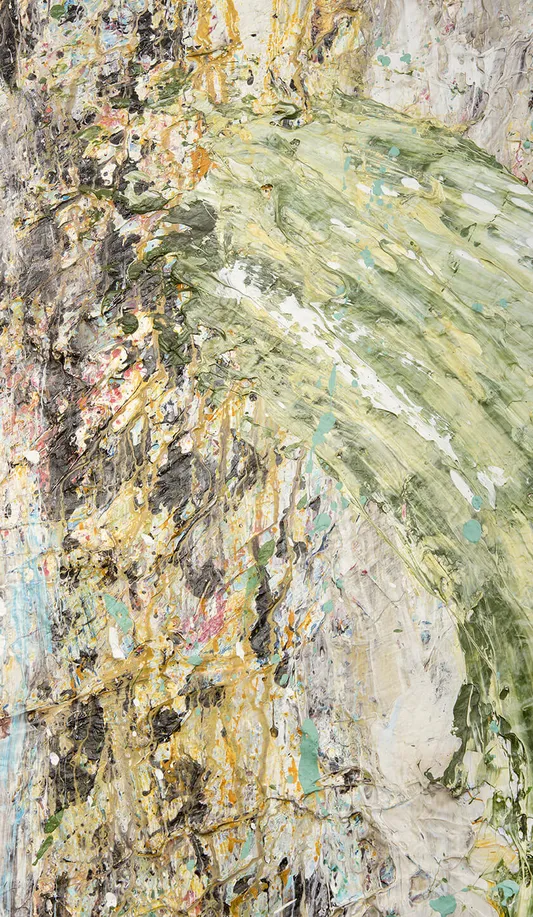
The abstracts were his first post-St Ives, post-Portway paintings. Instead, for example, of Portway’s cerebral and philosophical emphases in his finely tuned abstracts, Ainslie directed his efforts towards capturing the qualities of his remembered environment. For instance, his subconsciously recalled impressions of the Matobo Hills emerged as presences, along with scrubby features of the South African veld in paintings such as Totem and Veld Forms.
The landscape presences in these paintings are emotional, subconscious and intuitive gestures that flowed through the artist, who was open to their passage and form. This process refers to the disciplined engagement with paint by Abstract Expressionists such as the US-based artists Mark Rothko, Willem de Kooning and Robert Rauschenberg, whom Ainslie acknowledged.
His second exhibition was in 1973 in Pretoria. Eight works on canvas were titled Namib, one was Escarpment and two Kalahari. Among the oil-on-paper works, 11 had the word ‘baobab’ in their titles, two were called Namib and three Kalahari. With such a preponderance of specifically African references, Ainslie inserted his abstract paintings into the zone and tradition of local art dominated by White landscape painters. Instead of the pictorial control that such conventional landscapes attempted, Ainslie’s paintings used abstract resources to suggest the unmistakeably African in earth, plant and colour. It was not the place or thing that his paintings sought to depict but their atmosphere and immanence.
Insofar as the paintings as a whole are images, their content lies in what the paint invites the viewer to make possible. Here Ainslie has moved beyond Portway (whose later work became increasingly austere) and has found his own ‘voice’ by allowing paint to express the flow of the creative response passing through him.
Once Ainslie had mounted his two major exhibitions in the early 1970s, he began to assemble a growing group of students and employ teachers for the first time. But this developing enterprise and his opportunities to paint were disrupted every second year when the sites in Killarney (1973) and then in Forest Town (1975) were made unavailable by their owners.
When he moved into promising premises in Saxonwold (1977), he was soon required by the city council (the owners) to pay a higher rental and maintain the largely neglected property. It was then that his friends and supporters recognised his need for a permanent home, where he could both paint and teach in a stable environment. This led to the establishment of a trust, administered by a council, which formally employed Ainslie as its director.
Between 1977 and 1982, therefore, Ainslie was heavily engaged in a campaign to have the newly named Johannesburg Art Foundation’s tender for the premises in Saxonwold accepted by the City Management Committee. This was successful. By this, the city was granted a fully fledged arts centre without financial burden for itself and the JAF occupied a permanent home.
As its name suggests, it was more than just a school for people who wanted to learn to paint. It was the place to go to engage seriously with the making of art; to learn more about the connections between the visual and other forms of art; and where creativity was nurtured. The foundation’s working environment was clearly different from the burdens of apartheid outside it. For example, the JAF was South Africa’s first non-racial art school.
By now, Ainslie had developed a coherent teaching programme based on openness, individuality, nurturing creativity outside of theory and preconceptions, and without coercive systems or structures. This he formulated in a paper for a conference – The State of Art in South Africa, held at the University of Cape Town in 1979 – on his approach to the intrinsic importance of artists’ workshops.
In addressing this conference, Ainslie said artists should turn away from the past and confront the present realities of their context. He argued that it is ‘the creative act which transfigures the past’, that is, the creativity of the present. In so doing, teachers should use workshop methods for discovering the creativity of people in a process that meant encountering the exceptional, the unknown and the unexpected.
Ainslie was clear in stating that ‘I do not know how to make an artwork, nor do I know how to teach people to do it.’ He added, ‘Teaching consists of leading and being led towards the threshold of the unconditional.’
More on his approach to and work with artists’ workshops is in the section on Ainslie and teaching in section 5.
Secure location, full abstraction, creative workshops
1980–1989
This era represents Ainslie as an artist fully committed to making abstract paintings as his most emphatic contribution to his community and to his world. His two solo exhibitions at the Goodman Gallery in 1984 and 1986 mark a summit in his achievement as a painter.
There is abundant evidence that the JAF was functioning then as a remarkable centre for the arts, with the emphasis on the visual art of painting. Ainslie’s abstract work was never wholly separate from references to and intimations of landscape. Painting as an African in Africa, he acknowledged the history of abstraction in North American and European art, as well as elements from the East such as the ‘untrammelled’ tradition in Japan and China. And, most importantly, his work stands alongside the ancient traditions of abstraction in Africa, including South Africa.
By his focus on the power of paint to suggest and embody the beautiful, and in his strong sense of the poetic, Ainslie infused his abstract works with spiritual presence.
When hot heads in the liberation struggle took the view that art should be an overt ‘weapon of struggle’, Ainslie’s abstract works of the 1980s constituted a problem for his friend and admirer, Mongane Wally Serote. They met in London in 1987 and spent two nights and a day in unresolvable disagreement.
Fifteen years later, when Serote used to sit in the JAF at dawn to compose his poetry, surrounded by the late Ainslie’s major abstracts on the walls, he began to understand how such art, in response to changing light, addressed deep qualities in the human ability to reflect, change perspective and move beyond the ordinary limits of the self. Serote expressed his regret that he had not been able to tell Ainslie that.[12]
By 1984, the JAF had established itself broadly with the following individuals: Patrons: Ian Haggie, Harry Oppenheimer, Bill Wilson, Irene Menell. Initial Council: Ricky Burnett, Michael Gardiner (chair), John Hall, Irene Menell, David Morrison, Sipho Sepamla, Franka Severin. The council was augmented over time to reflect community and other interests.
A full history of the JAF would need to include the names of the staff and teachers, visiting artists, and the many participants in the life of the art foundation.
For example, the year 1984 at the JAF was marked by a proliferation of activities in addition to the regular full-time (three-year) and part-time courses. There were a number of public seminars on art movements; lunchtime lectures; workshops on poetry, dreams and creative writing; and seminars for staff and senior full-time students. There were also classes and school-holiday workshops for children, ranging in age from the very young to matric students. There was a gallery for the exhibition of artworks; a library of books and slides; and a bursary scheme. People seeking special skills could pursue watercolours, oils, sculpture, etching, drawing and egg tempera. The centre was never closed and functioned as a live, organic entity.
At its heart were the workshops for artists. Ainslie described their importance thus:
In the workshop, we have people of all sorts, rich and poor, new and old, black and white, and it works. We watch people’s lives changing and thereby changing ours; everybody contributes. We don’t need ‘political’ art, or ‘relevant’ art, or ‘folk’ art, or ‘african’ art, or ‘suburban’ art or ‘township’ art – it’s all too self-conscious. What we need is to get on with the job of discovering ourselves, and let the labels be used by the ideologists. Beuys [13] is right: all men are artists. They can all create their lives out of the raw material of their failed promises and defeated ambitions, because the promises that fail and ambitions that can be defeated are the raw stuff of the living stone. [14] I like Joseph Beuys for giving me the idea that the workshop is a social sculpture. [15]
The increasing depth and strength of the JAF’s focus on people’s creativity was shared in the 1980s by other initiatives. For example, in 1983, Darius and Catherine Brubeck, with vital assistance from Professor Chris Ballantine, persuaded the University of Natal in Durban to admit, at selected levels, gifted and creative musicians into the new jazz courses and activities in the Department of Music. Many of these were people whose musical proficiency was unquestionable but who had little or no formal schooling, no money, and no place to stay.[16]
Today, the University of KwaZulu-Natal is home to a thriving Centre for Jazz and Popular Music (CJPM), which, as the first university course in jazz in Africa, stimulated the inclusion of jazz in almost all South African music teaching programmes.
This example demonstrates that the JAF, unique in many aspects, was but one of many initiatives by diverse groups of people to find new ways of forming environments in which people’s creativity could find expression, free from the weight of officialdom and orthodoxy. In fact, if one draws a spider-like web of the various arts centres that were linked in the Transvaal (now Gauteng) alone, with the JAF as its centre, one can develop a complex pattern in which the many arts were interlinked and interacted with one another in the 1980s.
Further examples of creative activity at this time are the impact of Johannes Kerkorrel and the Gereformeerde Blues Band upon Afrikaner youth; the Market Theatre Laboratory’s programme of workshopping community plays; large poetry readings taking place in spaces between suburb and township; and the output of at least three adventurous publishers such as Ravan Press, Ad. Donker and David Philip. It is a regrettable fact that much of this creative energy was dispersed after 1990.
Notes
-
8
Elizabeth Castle, Controversial Ways of Seeing, catalogue for an exhibition curated at the Bag Factory, Newtown, towards a MAFA degree at the University of the Witwatersrand, June 2015, pp. 4–5. ↩
-
9
In an interview in the 1970s, Ainslie said about Portway’s painting, ‘I felt I was seeing paintings the like of which I had never seen in this country, that I had never seen in reproduction and I came upon a revelation of possibilities that I did not believe existed.’ Author unknown, Bill Ainslie 1157, undated, p. 10. ↩
-
10
Editorial article entitled ‘Bill Ainslie’, Artlook, July 1968, p. 16. ↩
-
11
Mark Gevisser, Lost and Found in Johannesburg (Johannesburg and Cape Town: Jonathan Ball, 2014), p. 135. ↩
-
12
Mongane Serote, interviewed by Elizabeth Castle, October 2013 for her MAFA degree: see footnote 8 above. ↩
-
13
Joseph Beuys (1921–1986) was a German artist who included debate, discussion and teaching in his definition of art. ↩
-
14
The stone overlooked by builders has particular value. ↩
-
15
Bill Ainslie, ‘An Artists’ Workshop – Flash in the Pan or a Brick that the Builders Rejected?’ Proceedings of ‘The State of Art in South Africa’ Conference (University of Cape Town, 1979), p. 87. ↩
-
16
Darius Brubeck and Catherine Brubeck, Playing the Changes (Pietermaritzburg: University of KwaZulu-Natal Press, 2023). ↩